One week and three days left in Venezuela!
This past week, we've been surveying the cemeteries looking for mosquitoes. This should have been a rapid and simple quest that is completed by now. Unfortunately, the trips to Mucuchíes (3000 m) and Mucurubá (2400 m) seem to have caused problems in two of the Malariología vehicles. Or maybe the problems were there before, it's hard to say since I don't know much about cars. But I can say that I have developed an appreciation for good cars and powerful trucks. I didn't understand the attraction before, but I definitely do now.
Another personal change is that I have gotten over all uneasiness regarding cemeteries. They used to freak me out a little bit, and I would hate it when they were part of our route in high school track practice. But now, we're working in cemeteries where the graves are so close as to be touching and I have to climb over the stones to get to the flower vases and check for larvae. I've skirted narrowly by open tombs, tripped over grass-covered crosses, and walked through gigantic spiderwebs. Of course, this has all been done in daylight with a sturdy reliable coworker.
I did a lot of data entry today, so here's a little discussion of the standings in Meagan vs. Mosquito: we surveyed 13 sites in Mérida, only 3 of which did not have mosquitos. I consider the 3 without mosquitos to be a small gain for us, since we get information lots of information from their absence but we didn't affect anything in the present. In the other 10 sites, we were sometimes able to treat the whole area and sometimes only half. All of our 5 Ejido sites had larvae, with a similar situation regarding access. In El Vigía, all 6 sites were positive for larvae. In fact, we came to expect that the majority of houses we entered had larvae, which is a bracing situation in terms of public health. Although we treated left and right, I'm sure it was only a small dent in the overall population.
After that rundown, I realize there may be some head-scratching about what I actually did all summer and what this information means. A quick description: after deciding on our sites within each city, two or three of us went to the requisite corner or landmark. This part often involved demonstrative hand-waving discussions with lots of "aquí" and "allí" and "no, no, no." Once that was done, we recorded temperature measurements and GPS points. Then we approached the first house, store, or building. Usually, a Malariología person spoke first and flashed their fancy badge while I tried to look amiable, non-intimidating, and Spanish-speaking. Once given permission to enter, one of us would ask questions about water supply and trash collection while the rest of us walked through the house looking for and recording the buckets, tanks, flower pots, vases, and other water containers. When one was found to have larvae, at least two of us would confer about species ID. By this time, the people living in the house would have figured out that I was not from Venezuela, and I fielded lots of questions about where I am from and why I am here. By and large, people are friendly and this is a lot of fun, and the older people had a tendency to give me all kinds of blessings and welcomes. However, sometimes people would manifest their curiosity by pointing at me and asking "does the skinny girl speak Spanish?" Then we would shake their hands and say "gracias" and "a la orden" many times and move to the next house.
A resolution: I will be extra nice to the people who come house-to-house and end up at mine. I have a very deep gratitude to everyone who offered us water, coffee, juice, and a place to sit in the shade during the extreme heat. I was especially touched by the very poor woman who pulled out her plastic chairs and her blackberry wine and by an older man who gave us tall glasses of hand-squeezed guyabana juice. Muchísimo gracias.
Showing posts with label Malariología. Show all posts
Showing posts with label Malariología. Show all posts
Friday, July 17, 2009

Monday, July 6, 2009
planning in El Vigía
Seven weeks down now, three to go. In fact, I should be arriving in the DC airport at just about this time in exactly three weeks. I'm pretty flagrantly counting down now, especially since Ryan will be back in the US around this time tomorrow night.
This is not to say that I haven't been having a great time here! I have had the exceptional luck to work with the wonderful Malariología group, who have dedicated much time and energy to getting this project off the ground and who have furthermore befriended me. I hope that my work will produce results that are interesting and useful to them, and I hope that they like the Yale t-shirts that I'm going to give them. They've given me a Combata Dengue shirt which is super awesome and has an upside-down (ie dead) Aedes mosquito on it, tell-tale white striped feet flailing in the air. I'll try to get a picture wearing it.
My professor from Yale arrived here on Friday morning. She's getting a first-hand view of my field work and methods, and over the weekend we met with a professor from ULA and with the jefe and Dr. Jose Carlos at Malariología. The jefe's 15-year daughter was there too, and laughed uproariously at just about every question I asked in Spanish (I'm actually quite a big hit with teenagers. At the posada in Mérida, the daughter of the dueños were super impressed that I had visited both Chicago and San Francisco, and a high school American kid tried to pick me up in the ice cream shop.) Anyway, my professor is pretty happy with my work so far, and we're discussing dropping my last city and working a bit more thoroughly on determining the upper limit of mosquito larval presence. Sorry Santana fans, that means we skip Tovar.
Our current city is El Vigía, which is about an hour and a world away from Mérida. It's HOT here and humid too, and not as historic or well-planned of a city. It feels a bit like the auto retail strips in Florida between where my grandpa lived in Fort Pierce and where he lives now in Port St. Lucie, except with small smoky restaurants stuck in between the larger commercial properties. I pick up criaderos (breeding sites, which are some kind of container with water) that are way to hot to support life. I can already tell that the larval density is higher here, which is great in terms of my project but difficult in terms of control. This hits on a guilty point for many public health researchers: we get excited about interesting data and complicated problems, but their existance means a great deal of trouble for lots of people. In this case, my conscience is eased a bit by the fact that we use larvicide to kill all the larvae that we find. It's quite satisfying and I recommend treating all of your temporary water containers.
I've been surprised by the lack of resources at the office here in El Vigía. I've become accustomed to thinking of Venezuela as a pretty developed country, but the satellite Malariología office has one computer with no internet and no maps of their own city anywhere in sight. There are no training programs or conferences and there are constant transportation problems. It makes me extremely grateful for the CDC and for all of the state health departments in the US. Happy Indepence Day, my American friends.
This is not to say that I haven't been having a great time here! I have had the exceptional luck to work with the wonderful Malariología group, who have dedicated much time and energy to getting this project off the ground and who have furthermore befriended me. I hope that my work will produce results that are interesting and useful to them, and I hope that they like the Yale t-shirts that I'm going to give them. They've given me a Combata Dengue shirt which is super awesome and has an upside-down (ie dead) Aedes mosquito on it, tell-tale white striped feet flailing in the air. I'll try to get a picture wearing it.
My professor from Yale arrived here on Friday morning. She's getting a first-hand view of my field work and methods, and over the weekend we met with a professor from ULA and with the jefe and Dr. Jose Carlos at Malariología. The jefe's 15-year daughter was there too, and laughed uproariously at just about every question I asked in Spanish (I'm actually quite a big hit with teenagers. At the posada in Mérida, the daughter of the dueños were super impressed that I had visited both Chicago and San Francisco, and a high school American kid tried to pick me up in the ice cream shop.) Anyway, my professor is pretty happy with my work so far, and we're discussing dropping my last city and working a bit more thoroughly on determining the upper limit of mosquito larval presence. Sorry Santana fans, that means we skip Tovar.
Our current city is El Vigía, which is about an hour and a world away from Mérida. It's HOT here and humid too, and not as historic or well-planned of a city. It feels a bit like the auto retail strips in Florida between where my grandpa lived in Fort Pierce and where he lives now in Port St. Lucie, except with small smoky restaurants stuck in between the larger commercial properties. I pick up criaderos (breeding sites, which are some kind of container with water) that are way to hot to support life. I can already tell that the larval density is higher here, which is great in terms of my project but difficult in terms of control. This hits on a guilty point for many public health researchers: we get excited about interesting data and complicated problems, but their existance means a great deal of trouble for lots of people. In this case, my conscience is eased a bit by the fact that we use larvicide to kill all the larvae that we find. It's quite satisfying and I recommend treating all of your temporary water containers.
I've been surprised by the lack of resources at the office here in El Vigía. I've become accustomed to thinking of Venezuela as a pretty developed country, but the satellite Malariología office has one computer with no internet and no maps of their own city anywhere in sight. There are no training programs or conferences and there are constant transportation problems. It makes me extremely grateful for the CDC and for all of the state health departments in the US. Happy Indepence Day, my American friends.
Wednesday, June 10, 2009
H1N1 and other strange things
I don't have much time, but in short, the past three days have been a little crazy. But good. I was asked to help out with prevention for H1N1 (confirmed in El Vigía on Sunday), which is sort of hilarious and intimidating at the same time since I sort of resolutely ignored most of the flu stuff that was going on around me this year. But I'm doing my best to sort through the information out there, to contact people who know more than me, and to give them what I can.
I've done five sites in Mérida in the past three days. On Monday, we started off with a government educational facility where a man insisted on pronouncing "Yale" in the "Spanish" way and continued through a construction site unexpectedly teeming with larvae and on to an apartment where we were denied access since we might kidnap the residents (I know that I look pretty intimidating). Our site yesterday was the teleférico station, which is the longest cable car system in the world but unfortunately closed. In the afternoon, we decided to map out all of the rest of our sites at once, but the office lost electricity and we didn't have a random number table. So I wrote the digits out on ten pieces of paper and had my team pick the numbers, which attracted quite a bit of attention since we were in the atrium in order to use the sunlight. Today, we began with a farm where we found ginormous unidentifiable mosquito larvae, which we brought back to ULA to grow up and identify as adults. Then we went cavorting through the mountains to two other sites, at one point discussing the project with the owner of a trout farm. I have no idea what is going to happen tomorrow.
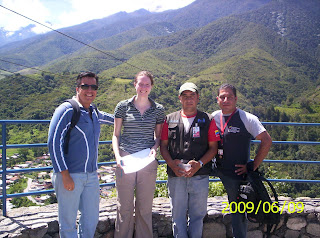
But here's a picture of Tuesday's team: Ivan (UCV), me, Sergio, and Henry (both Malariología). We're at the teleférico station. Beautiful workplace, no?
I've done five sites in Mérida in the past three days. On Monday, we started off with a government educational facility where a man insisted on pronouncing "Yale" in the "Spanish" way and continued through a construction site unexpectedly teeming with larvae and on to an apartment where we were denied access since we might kidnap the residents (I know that I look pretty intimidating). Our site yesterday was the teleférico station, which is the longest cable car system in the world but unfortunately closed. In the afternoon, we decided to map out all of the rest of our sites at once, but the office lost electricity and we didn't have a random number table. So I wrote the digits out on ten pieces of paper and had my team pick the numbers, which attracted quite a bit of attention since we were in the atrium in order to use the sunlight. Today, we began with a farm where we found ginormous unidentifiable mosquito larvae, which we brought back to ULA to grow up and identify as adults. Then we went cavorting through the mountains to two other sites, at one point discussing the project with the owner of a trout farm. I have no idea what is going to happen tomorrow.
But here's a picture of Tuesday's team: Ivan (UCV), me, Sergio, and Henry (both Malariología). We're at the teleférico station. Beautiful workplace, no?

Subscribe to:
Posts (Atom)