Yesterday, I went to 11 am Mass at the ULA campus chapel. I've gone before, but only to the 5 pm Mass. It was all normal until we got to the Our Father, when the choir started playing the opening notes to "The Sound of Silence."
Yes, by Simon & Garfunkel.
I tried as hard as I could to not hear the words "and the words of the prophet are written on the subway walls" when I should have been praying, but it was not possible. I also tried not to look shocked, but I'm sure I failed there too. Maybe the Venezuelans don't have my level of distraction since they have to translate the English.
In Plaza Bolivar, there is a man who plays the flute and alternates between this song and the theme from Titanic. Now I wonder if he's playing "The Sound of Silence" or "Our Father," and if the Hail Mary has been set to that 1990s masterpiece.
Showing posts with label Universidad de Los Andes. Show all posts
Showing posts with label Universidad de Los Andes. Show all posts
Monday, July 20, 2009

Monday, July 6, 2009
planning in El Vigía
Seven weeks down now, three to go. In fact, I should be arriving in the DC airport at just about this time in exactly three weeks. I'm pretty flagrantly counting down now, especially since Ryan will be back in the US around this time tomorrow night.
This is not to say that I haven't been having a great time here! I have had the exceptional luck to work with the wonderful Malariología group, who have dedicated much time and energy to getting this project off the ground and who have furthermore befriended me. I hope that my work will produce results that are interesting and useful to them, and I hope that they like the Yale t-shirts that I'm going to give them. They've given me a Combata Dengue shirt which is super awesome and has an upside-down (ie dead) Aedes mosquito on it, tell-tale white striped feet flailing in the air. I'll try to get a picture wearing it.
My professor from Yale arrived here on Friday morning. She's getting a first-hand view of my field work and methods, and over the weekend we met with a professor from ULA and with the jefe and Dr. Jose Carlos at Malariología. The jefe's 15-year daughter was there too, and laughed uproariously at just about every question I asked in Spanish (I'm actually quite a big hit with teenagers. At the posada in Mérida, the daughter of the dueños were super impressed that I had visited both Chicago and San Francisco, and a high school American kid tried to pick me up in the ice cream shop.) Anyway, my professor is pretty happy with my work so far, and we're discussing dropping my last city and working a bit more thoroughly on determining the upper limit of mosquito larval presence. Sorry Santana fans, that means we skip Tovar.
Our current city is El Vigía, which is about an hour and a world away from Mérida. It's HOT here and humid too, and not as historic or well-planned of a city. It feels a bit like the auto retail strips in Florida between where my grandpa lived in Fort Pierce and where he lives now in Port St. Lucie, except with small smoky restaurants stuck in between the larger commercial properties. I pick up criaderos (breeding sites, which are some kind of container with water) that are way to hot to support life. I can already tell that the larval density is higher here, which is great in terms of my project but difficult in terms of control. This hits on a guilty point for many public health researchers: we get excited about interesting data and complicated problems, but their existance means a great deal of trouble for lots of people. In this case, my conscience is eased a bit by the fact that we use larvicide to kill all the larvae that we find. It's quite satisfying and I recommend treating all of your temporary water containers.
I've been surprised by the lack of resources at the office here in El Vigía. I've become accustomed to thinking of Venezuela as a pretty developed country, but the satellite Malariología office has one computer with no internet and no maps of their own city anywhere in sight. There are no training programs or conferences and there are constant transportation problems. It makes me extremely grateful for the CDC and for all of the state health departments in the US. Happy Indepence Day, my American friends.
This is not to say that I haven't been having a great time here! I have had the exceptional luck to work with the wonderful Malariología group, who have dedicated much time and energy to getting this project off the ground and who have furthermore befriended me. I hope that my work will produce results that are interesting and useful to them, and I hope that they like the Yale t-shirts that I'm going to give them. They've given me a Combata Dengue shirt which is super awesome and has an upside-down (ie dead) Aedes mosquito on it, tell-tale white striped feet flailing in the air. I'll try to get a picture wearing it.
My professor from Yale arrived here on Friday morning. She's getting a first-hand view of my field work and methods, and over the weekend we met with a professor from ULA and with the jefe and Dr. Jose Carlos at Malariología. The jefe's 15-year daughter was there too, and laughed uproariously at just about every question I asked in Spanish (I'm actually quite a big hit with teenagers. At the posada in Mérida, the daughter of the dueños were super impressed that I had visited both Chicago and San Francisco, and a high school American kid tried to pick me up in the ice cream shop.) Anyway, my professor is pretty happy with my work so far, and we're discussing dropping my last city and working a bit more thoroughly on determining the upper limit of mosquito larval presence. Sorry Santana fans, that means we skip Tovar.
Our current city is El Vigía, which is about an hour and a world away from Mérida. It's HOT here and humid too, and not as historic or well-planned of a city. It feels a bit like the auto retail strips in Florida between where my grandpa lived in Fort Pierce and where he lives now in Port St. Lucie, except with small smoky restaurants stuck in between the larger commercial properties. I pick up criaderos (breeding sites, which are some kind of container with water) that are way to hot to support life. I can already tell that the larval density is higher here, which is great in terms of my project but difficult in terms of control. This hits on a guilty point for many public health researchers: we get excited about interesting data and complicated problems, but their existance means a great deal of trouble for lots of people. In this case, my conscience is eased a bit by the fact that we use larvicide to kill all the larvae that we find. It's quite satisfying and I recommend treating all of your temporary water containers.
I've been surprised by the lack of resources at the office here in El Vigía. I've become accustomed to thinking of Venezuela as a pretty developed country, but the satellite Malariología office has one computer with no internet and no maps of their own city anywhere in sight. There are no training programs or conferences and there are constant transportation problems. It makes me extremely grateful for the CDC and for all of the state health departments in the US. Happy Indepence Day, my American friends.
Wednesday, June 10, 2009
H1N1 and other strange things
I don't have much time, but in short, the past three days have been a little crazy. But good. I was asked to help out with prevention for H1N1 (confirmed in El Vigía on Sunday), which is sort of hilarious and intimidating at the same time since I sort of resolutely ignored most of the flu stuff that was going on around me this year. But I'm doing my best to sort through the information out there, to contact people who know more than me, and to give them what I can.
I've done five sites in Mérida in the past three days. On Monday, we started off with a government educational facility where a man insisted on pronouncing "Yale" in the "Spanish" way and continued through a construction site unexpectedly teeming with larvae and on to an apartment where we were denied access since we might kidnap the residents (I know that I look pretty intimidating). Our site yesterday was the teleférico station, which is the longest cable car system in the world but unfortunately closed. In the afternoon, we decided to map out all of the rest of our sites at once, but the office lost electricity and we didn't have a random number table. So I wrote the digits out on ten pieces of paper and had my team pick the numbers, which attracted quite a bit of attention since we were in the atrium in order to use the sunlight. Today, we began with a farm where we found ginormous unidentifiable mosquito larvae, which we brought back to ULA to grow up and identify as adults. Then we went cavorting through the mountains to two other sites, at one point discussing the project with the owner of a trout farm. I have no idea what is going to happen tomorrow.
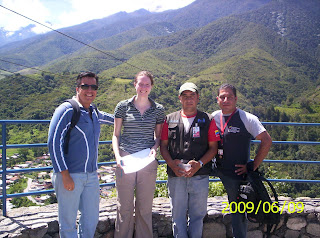
But here's a picture of Tuesday's team: Ivan (UCV), me, Sergio, and Henry (both Malariología). We're at the teleférico station. Beautiful workplace, no?
I've done five sites in Mérida in the past three days. On Monday, we started off with a government educational facility where a man insisted on pronouncing "Yale" in the "Spanish" way and continued through a construction site unexpectedly teeming with larvae and on to an apartment where we were denied access since we might kidnap the residents (I know that I look pretty intimidating). Our site yesterday was the teleférico station, which is the longest cable car system in the world but unfortunately closed. In the afternoon, we decided to map out all of the rest of our sites at once, but the office lost electricity and we didn't have a random number table. So I wrote the digits out on ten pieces of paper and had my team pick the numbers, which attracted quite a bit of attention since we were in the atrium in order to use the sunlight. Today, we began with a farm where we found ginormous unidentifiable mosquito larvae, which we brought back to ULA to grow up and identify as adults. Then we went cavorting through the mountains to two other sites, at one point discussing the project with the owner of a trout farm. I have no idea what is going to happen tomorrow.
But here's a picture of Tuesday's team: Ivan (UCV), me, Sergio, and Henry (both Malariología). We're at the teleférico station. Beautiful workplace, no?

Wednesday, June 3, 2009
No Hay Luz
 Today I switched cabañas. Previously, Adriana and I were staying in Cabañas Ana Cristina. We had a small apartment with two bedrooms, a kitchen, and a bathroom that was way way high up in Santa Rosa. The pictures are the view from our balcony (the one with me is a bit blurry, since we were trying to get lots of mountains in the pictures while simultaneously providing proof that I am actually alive). However, Adriana went back to Caracas today and is being replaced by Juan Carlos (the prof), Nelson (the lab tech), and Ivan (the nice guy who invited Sarah and I to the beach). They should be arriving any moment now. I hope so, anyway. And later I'll post pictures of the new place!
There have been a series of power outages here in the past few days. Last night, we had an outage for about two hours, and there was another for two hours this afternoon. I found out that the afternoon outage was actually a planned rationing step. It was a bit frustrating, since most of the things that I needed to get done today involved electricity -- light for drawing my map sites, a computer to apply for image acquisition, electricity for laundry. There is a Spanish post-doc here who sat on the bench outside the lab and commiserated with me, and then we were joined by a very nice prof in entomology who starting raving about the Ithaca music scene. He knows the guys in Donna the Buffalo (whose CD Marne gave me) and loves the Trumansburg music festival. He visited Yale in the late 90's and he thinks that New Haven is pretty, if a bit rough. I raised my eyebrows and asked "and Caracas?" and he conceded the point.
When I was packing for Venezuela, Marylee (Ryan's mom) insisted that I borrow her Swiss Army knife. These things are the ultimate in gadgetry, and it has turned out to be the single most useful item that I have ever brought with me on any trip. We've used this one to chop up food, to cut open packages, to open cans and bottles, and to put batteries in our devices. I've even used the magnifying glass to read the teeny print on one of the maps that I have. And yes, I'm pretty sure that using the magnifying glass on a Swiss Army knife to fix a real problem makes me way cool.

Saturday, May 30, 2009
Welcome to Mérida!
Hi there, everyone! Thanks so much for your comments and your emails. I'll do my best to keep up!
On Thursday morning, Adriana and I flew to El Vigía and then took a bus to Mérida, which is high in the Andes and bordered on all sides by mountains. It will be my first site for the project. On Friday morning, we met with the aquatic insect group at the Universidad de Los Andes. They were extraordinarily helpful and gave lots of wonderful feedback regarding the project, including potential site changes. We're in the midst of revising that now. Also, they gave us contact information to obtain the offical dengue numbers for the state. We tried to meet up with the doctor who has the information, but a demonstration in the middle of the city made the route impassable. We're meeting tomorrow instead. Also, we went to the mapatecas (the awesome word for map libraries!) and found maps for the cities that we want to use. Unfortunately some are nearly 50 years old, and the region has changed much, but we'll work on supplementing that bare-bones information with Google Earth or other satellite data. We have to return to the mapateca on Monday, since the electricity cut out just as we were about to print. It was a long day, but this was all a huge amount of work to get done.
Adriana has been super wonderful. On Thursday, I was stopped in the airport by the people doing swine flu surveillance and sent to the public health desk. This was despite the fact that I've been in the country longer than the incubation period, but I decided not to argue very much with the nice soldier. Adriana struck up a conversation with the public health woman and got the contact information for the dengue surveillance people in the city. It was pretty awesome. She's clearly very good at convincing people to give us information, and I'm trying to learn Spanish tricks from her.
My Spanish is improving amazingly. Even I can tell. I'm starting to use it reflexively to ask and answer questions, and I no longer hesitate over every word. A very strange thing has also started to happen where the words for things just fill themselves in, even though I thought that I had forgotten them years ago. It's far from fluent, but it's definitely better.
OK, the cyber cafe is closing. Oops. Ciao!
On Thursday morning, Adriana and I flew to El Vigía and then took a bus to Mérida, which is high in the Andes and bordered on all sides by mountains. It will be my first site for the project. On Friday morning, we met with the aquatic insect group at the Universidad de Los Andes. They were extraordinarily helpful and gave lots of wonderful feedback regarding the project, including potential site changes. We're in the midst of revising that now. Also, they gave us contact information to obtain the offical dengue numbers for the state. We tried to meet up with the doctor who has the information, but a demonstration in the middle of the city made the route impassable. We're meeting tomorrow instead. Also, we went to the mapatecas (the awesome word for map libraries!) and found maps for the cities that we want to use. Unfortunately some are nearly 50 years old, and the region has changed much, but we'll work on supplementing that bare-bones information with Google Earth or other satellite data. We have to return to the mapateca on Monday, since the electricity cut out just as we were about to print. It was a long day, but this was all a huge amount of work to get done.
Adriana has been super wonderful. On Thursday, I was stopped in the airport by the people doing swine flu surveillance and sent to the public health desk. This was despite the fact that I've been in the country longer than the incubation period, but I decided not to argue very much with the nice soldier. Adriana struck up a conversation with the public health woman and got the contact information for the dengue surveillance people in the city. It was pretty awesome. She's clearly very good at convincing people to give us information, and I'm trying to learn Spanish tricks from her.
My Spanish is improving amazingly. Even I can tell. I'm starting to use it reflexively to ask and answer questions, and I no longer hesitate over every word. A very strange thing has also started to happen where the words for things just fill themselves in, even though I thought that I had forgotten them years ago. It's far from fluent, but it's definitely better.
OK, the cyber cafe is closing. Oops. Ciao!
Subscribe to:
Posts (Atom)